ART STATEMENT
Monotypes:
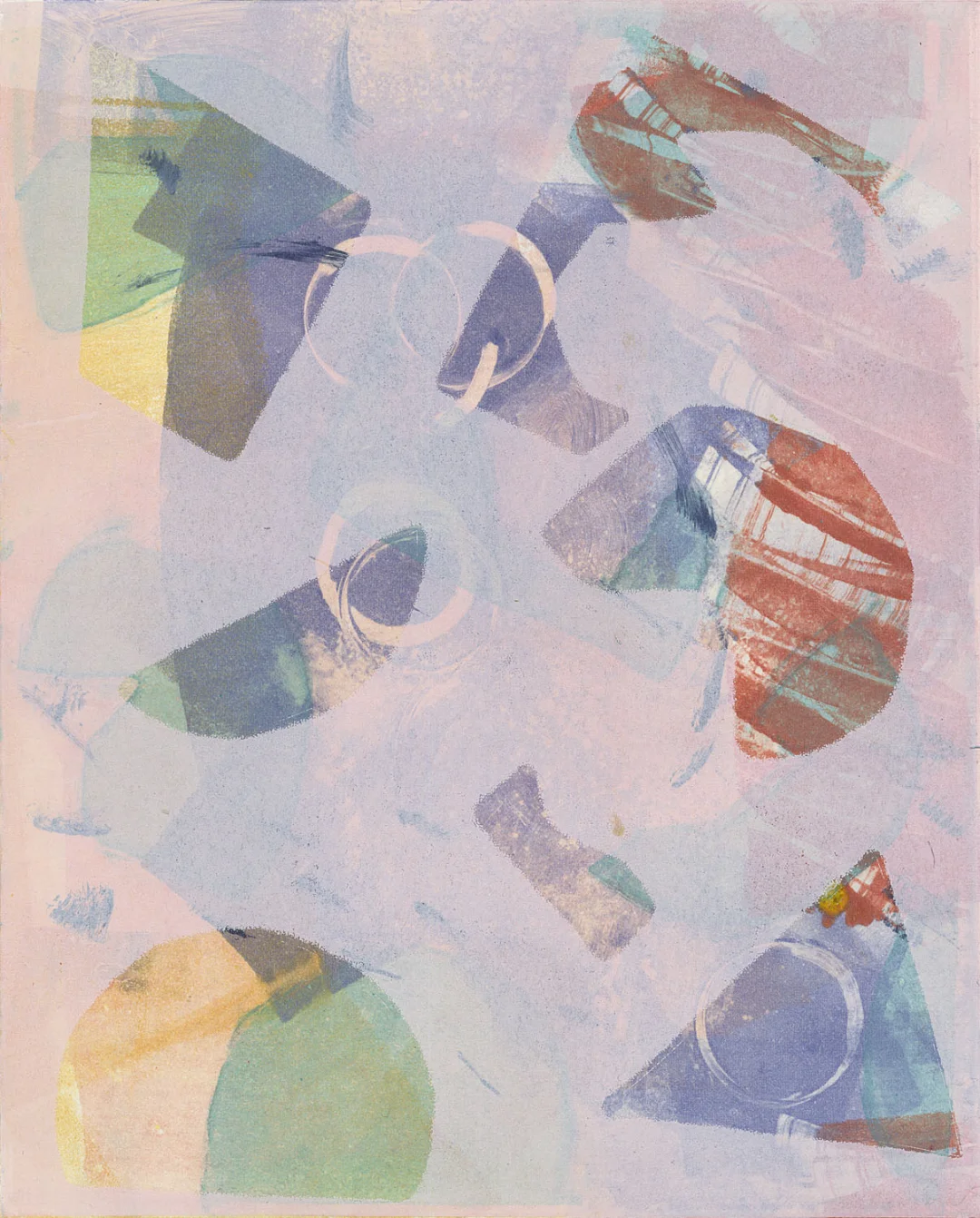
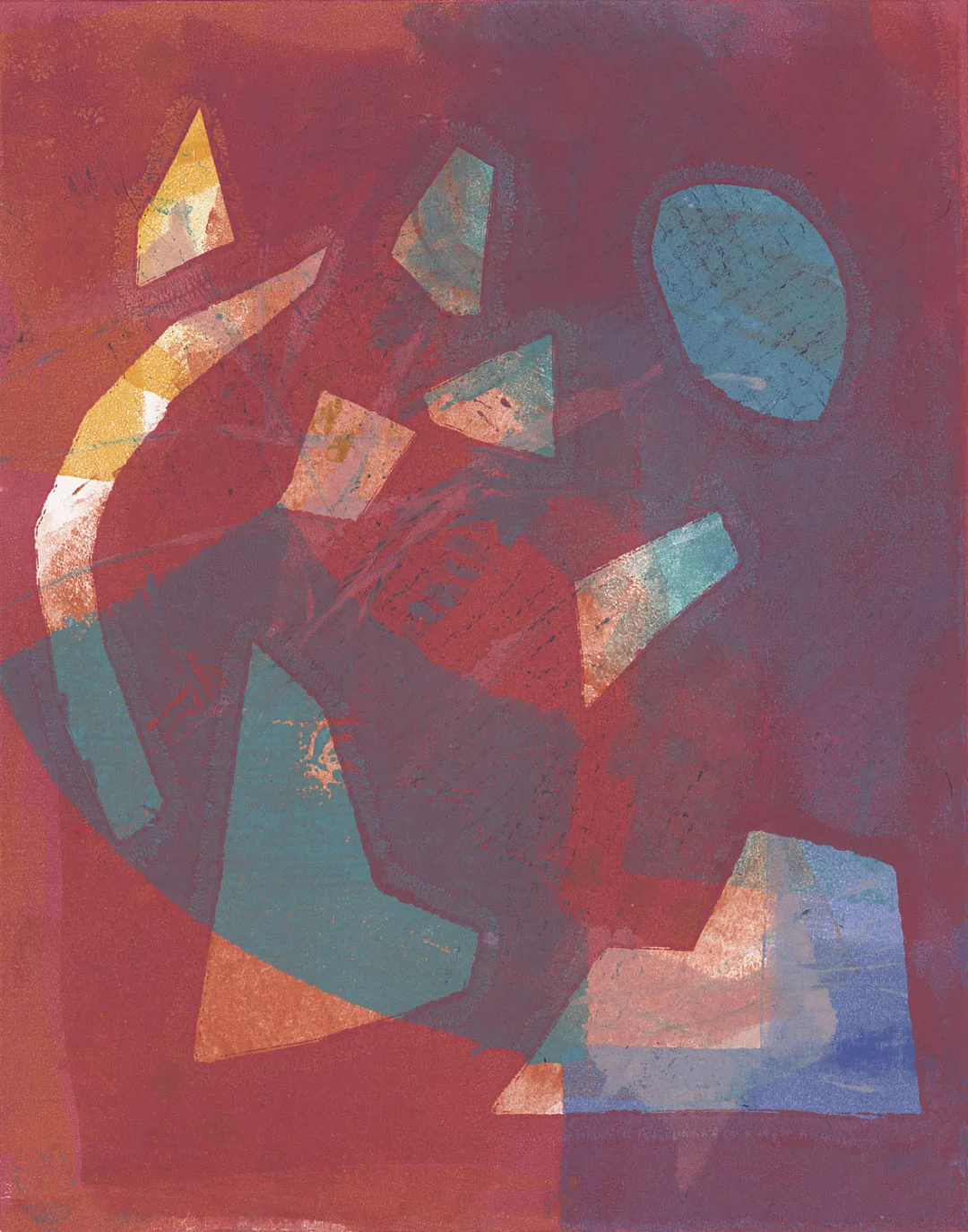
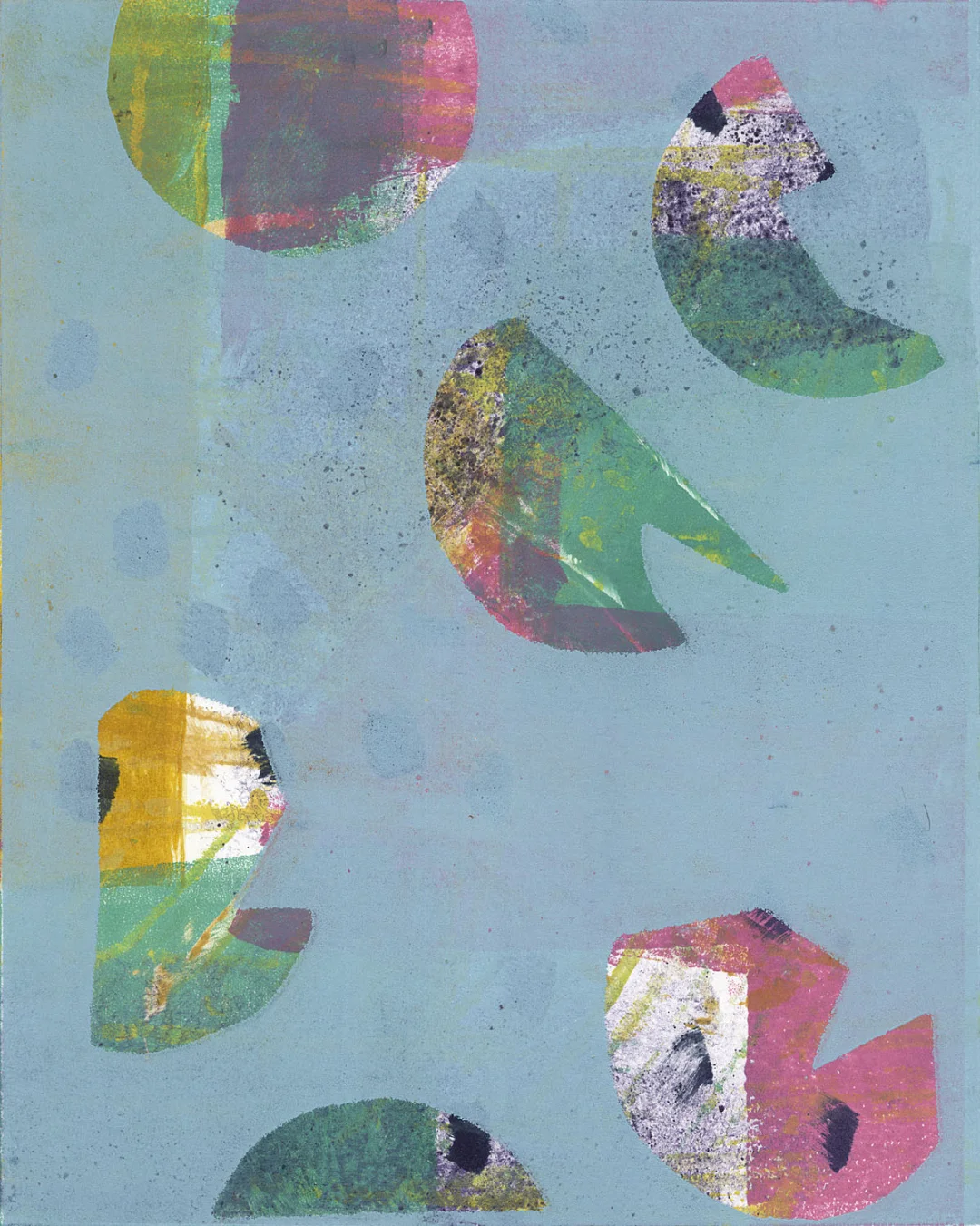
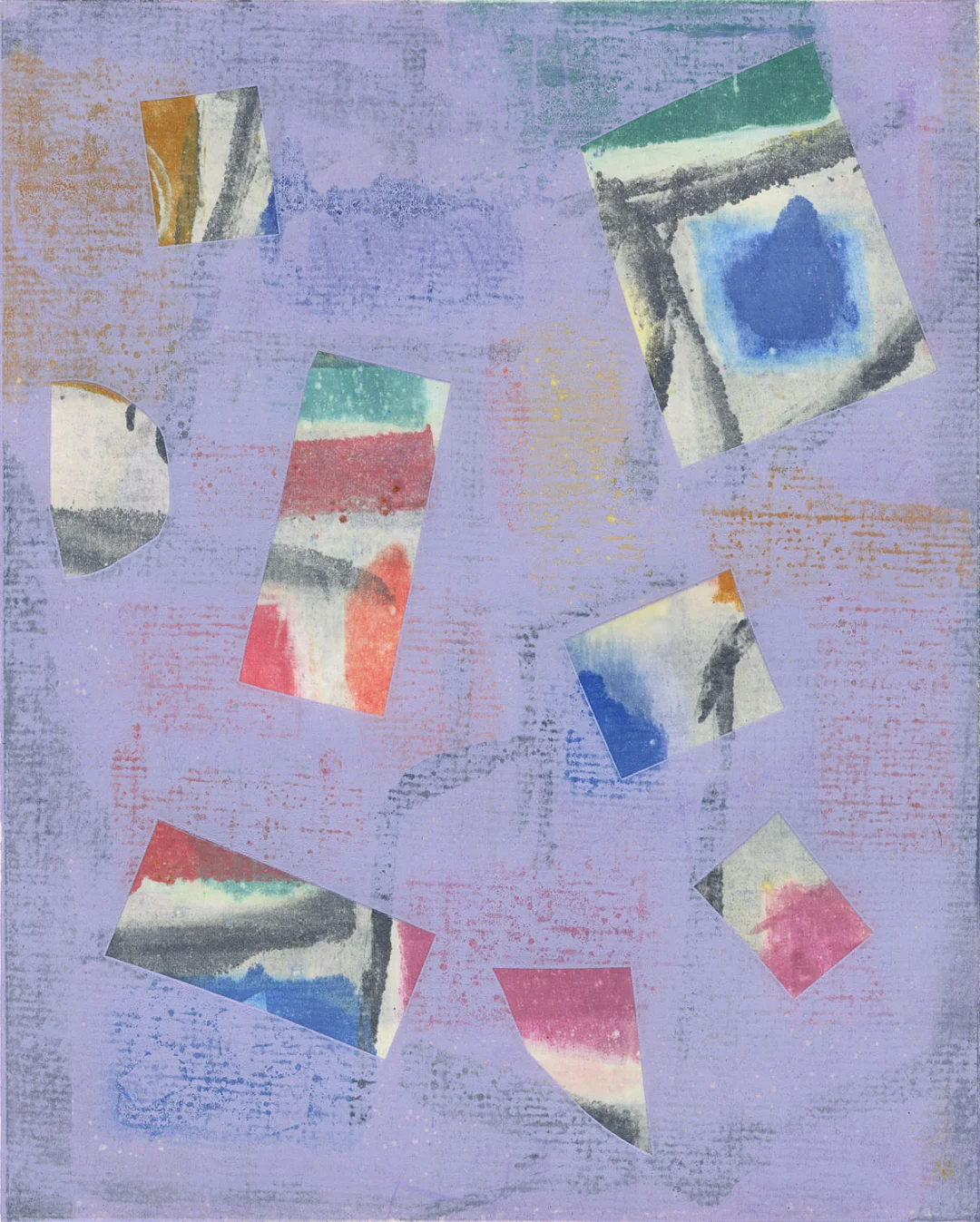
My work began in painting and collage, practices rooted in layering, intuition, and the gradual building of surfaces. When I turned to printmaking — specifically monotypes — I found a process that felt immediately familiar and yet fundamentally different. The hands-on engagement was the same: applying ink to a plate using stencils, marks, and pure color. When the inked plate goes through the press and the paper lifts I never know exactly how the print will emerge, there I is always the element of surprise! That tension between intention and discovery became central to how I work.
Working with abstract shapes and layered color, I became less interested in defining images than in suggesting them. The abstraction is deliberate and complete — concerned more purely with color relationships and spatial tension than with representation. Forms accumulate and interact, and the result is something the eye must negotiate rather than simply read.
What draws me most deeply to monotype is what happens between the layers. In painting or collage, earlier marks are often covered over, buried. In monotype, the underlayers remain present, breathing through the surface of what comes after. The result is a kind of visual archaeology — the viewer senses depth and history without being able to fully read it. That ambiguity is not a byproduct of the process. It has become the work itself.
Paintings
I am moving towards abstraction without the heavy baggage of landscape. The new collage work energizes me, allows me to be more playful as I feel there are less restrictions. This “landscape reconstructed” allows me to explore the nature of space, literal space as a vision from space or just above or under the ground, or architecture within the landscape or perhaps no reference to anything. I find I don’t have to have a horizon line and that is the principle freeing element.
I like to dive right in with art materials and play, putting my attention on composition and depth of color. Starting with two contrasting colors, I add white and black to each of those colors. All of the various hues and values are used with the addition of a highlighted surprise. Once I have decided on my palette, I start by laying down a piece of collage, adding darker colors, then add lighter colors, going back and forth in a dialogue with the composition. The next step is to play with mark making, paint swatches, stencils, and any art material I have on hand.
I find I have to make art, I have to create. Making art feeds me, makes me feel energized, relevant. If I am not making art I find myself doing busy work, filling time with minutia, or spending way too much time on the computer. The process of creating takes me into an alternate, life-giving space.
ABOUT
Andrea E. Leland is an artist who currently resides in Petaluma, California. Originally from Quebec, Canada, Leland received her MFA from the School of the Art Institute in Chicago. For the past thirty years she has traveled throughout the Caribbean observing, participating in and documenting its culture and natural beauty, all of which has influenced her artwork. Ten years ago Leland relocated to Petaluma from Chicago, Illinois and currently enjoys living in Sonoma County where the light, the nearby ocean and the flora and fauna provides a visually stimulating environment for her work.
In addition to painting and drawing, Leland has directed and produced several documentary films about culture and artistic expression in the Caribbean. Currently, she is concentrating on producing artwork. Her paintings, drawings and documentaries have been exhibited nationally and internationally and are in numerous private collections.
MY PATH
I began my artistic training, at the School of the Art Institute in Chicago in the ceramics department. From there I moved into painting and an interest in self-taught outsider and indigenous art. During my MFA years, I took some time to travel to an island in the Caribbean to study the influences and resources the artists on the island drew from to make their art. A publication ensued and a lifelong interest in indigenous cultures of the Caribbean. I subsequently moved to the Virgin Islands 1/2 the year.
From writing I moved into filmmaking, a much more direct form of capturing the cultures I was observing. These observations also had a profound influence on my paintings. For the next 30+ years I was making films alternating with painting in my studio. Each film took years to produce, direct and distribute, and is a very collaborative effort. Unlike filmmaking, painting provided me with a meditative, direct way to express much of what I was seeing and feeling. After making my final film which won an EMMY, I felt it was time to leave the making of films behind and concentrate on my own artwork rather than filming others. I moved back into my studio and began to make monotypes and paint.